Enough
Justice, mercy, humility, and grace

I’ve got this plaque hanging up in my office. It’s wild, really, to think that I was once entrusted with a badge as a 20-something rookie prosecutor. I wasn’t really “law enforcement,” but that didn’t stop the lunch crew from flashing it for the police discount at Chipotle. If you fulfilled your 3-year commitment to the office, you were allowed to have it encased and keep it. My dearest friend from the office, who was charged with designing and gifting me mine, asked if there was anything specific I’d like inscribed on it. There was never any doubt in my mind:
Do justice. Love mercy. Walk humbly.
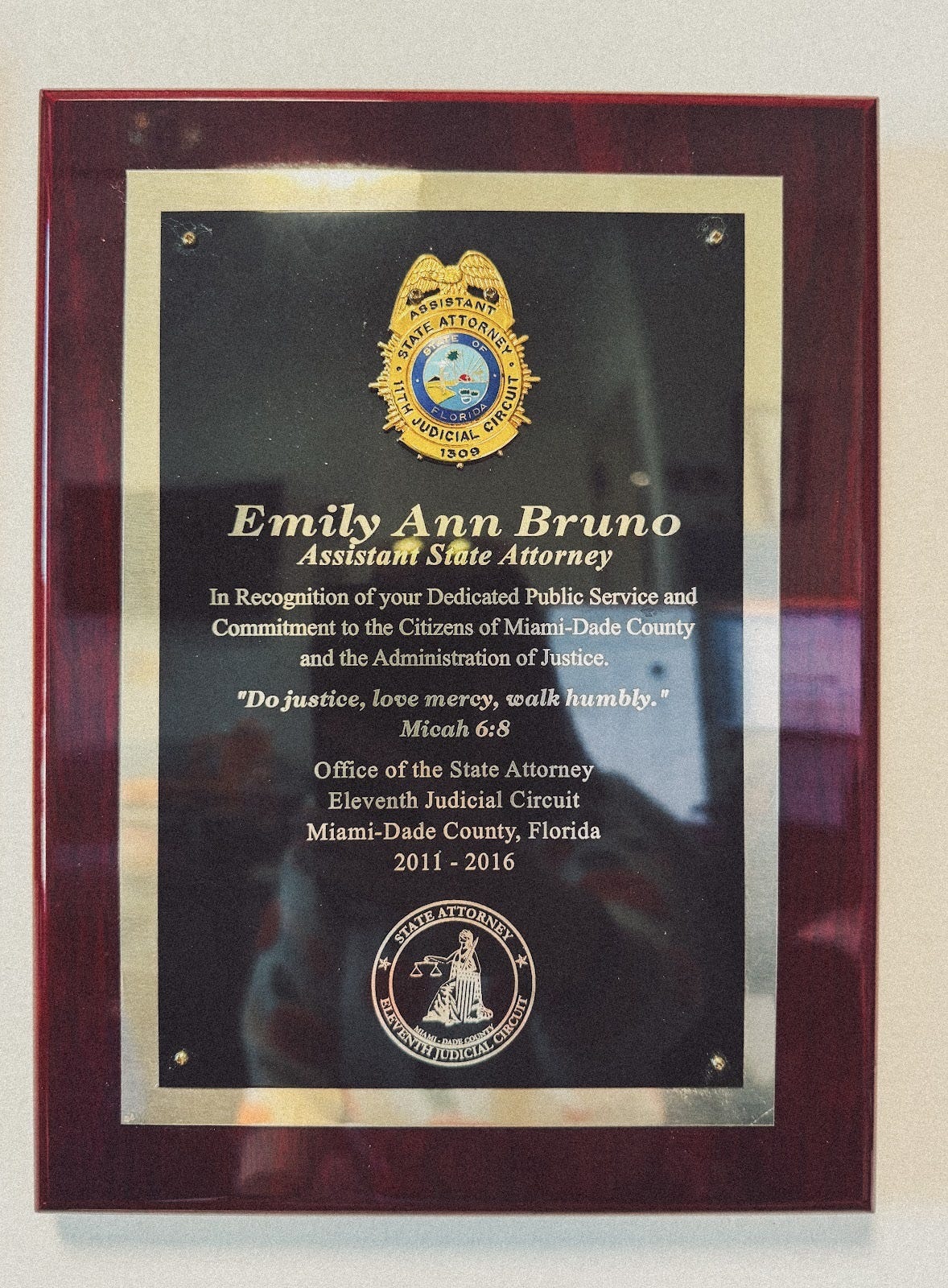
I’d once wholeheartedly believed that my career in the criminal justice system was a way of living out these prophetic ethics. I mean, come on… it’s the criminal justice system. Mercy was the counter balance that stopped you short of throwing the book at everyone whose case fell on your desk. And walking humbly? Well, the abysmal salaries they paid us to try to live in Miami certainly emphasized the humility of a public servant.
I was so proud of this plaque. Of having earned this plaque and the right to attach these significant, biblical words to it. To claim these words for my life.
These words from verse 8 are familiar and beloved to many, but the preceding text reveals a fascinatingly legal context: a divine lawsuit. How fitting, right?
Hear what the LORD says: Rise, plead your case before the mountains, and let the hills hear your voice. Hear, you mountains, the case of the LORD, and you enduring foundations of the earth, for the LORD has a case against his people, and he will contend with Israel.
“O my people, what have I done to you? In what have I wearied you? Answer me! For I brought you up from the land of Egypt and redeemed you from the house of slavery, and I sent before you Moses, Aaron, and Miriam. O my people, remember now what King Balak of Moab devised, what Balaam son of Beor answered him, and what happened from Shittim to Gilgal, that you may know the saving acts of the LORD.”
“With what shall I come before the LORD and bow myself before God on high? Shall I come before him with burnt offerings, with calves a year old? Will the LORD be pleased with thousands of rams, with ten thousands of rivers of oil? Shall I give my firstborn for my transgression, the fruit of my body for the sin of my soul?”
He has told you, O mortal, what is good, and what does the LORD require of you but to do justice and to love kindness and to walk humbly with your God?
And so the scene set is something like a prosecution, imagined as brought by God against the people. In response, the people propose increasingly severe remedies to resolve the case: a burnt offering of young calves, ten thousand rams, ten thousand rivers of oil… all the way to offering up the firstborn son. These are perhaps exaggerated offers, but with my background in prosecuting and my current work in criminal justice policy, it touches on a theme I often see in today’s world and its punitive approach to justice: when is it ever enough?
Just this week, we heard a bill on the floor of the Florida Senate mandating a life sentence… as in you spend the rest of your life in prison without parole, no matter what… for anyone convicted of manslaughter of a cop.
Nevermind that manslaughter is by definition an unintentional killing.
Nevermind that the manslaughter of just a normie, non-cop like you and me has a maximum exposure of 15 years, because our law has always recognized the lessened culpability of the offense as compared murder.
Nevermind that this bill was inspired by a real case where the killer was sentenced to 30 years in prison on a manslaughter charge (after application of a firearm enhancement), or that this sentence-to-the-bulk-of-a-young-man’s-adult-life was considered so outrageously low by some that they decided the law had to be changed for everyone.
When is it ever enough?
This week, the governor also signed the third death warrant of this just-budding year, after a record-breaking 19 executions in 2025. Such pace makes you wonder if the governor is trying to break the record once again. Will there ever be enough executions to satisfy the societal urge for vengeance?
We keep increasing penalties, incarcerating more people, and killing more people. When is it ever enough? What we see in Micah 6 is that the people keep escalating the proposed remedies in the divine prosecution, to the point of killing a firstborn son. At the heart of this inquiry is the same question… when is it ever enough?
“Enough” can feel like an elusive concept, as we keep adding “more” in search of it. The prophet’s answer, which is God’s answer, is to stop thinking of “enough” as achievable through “more.” Our search for “more” often distorts justice, as Micah and minimum mandatories show us. There is not some threshold quantity of justice, mercy, or humility we ought to strive for or must achieve; rather, these qualities are a posture God asks us to take as we go through the world.
When we do that – all that God asks – we find our way to enough.
These days, I have more of a strained relationship with the plaque in my office and its inscription, although I do leave it hanging. I regret what it represents: the role I played in furthering the police state, mass incarceration, and institutionalized racism. I am haunted by the faces I remember (and, maybe more so, the ones I don’t) of all the people I helped put in prison. And I also regret wanting to claim a Micah 6:8 life and thinking I’d somehow earned a “right” to that inscription based on things I’d accomplished in a career. Weeks like this past one, I come face to face with what these systems do and am forced to reckon with what I did as part of them. A year like this past one, we all see the natural outgrowth of the policing apparatus we’ve created and the authoritarian mindsets we’ve fostered as the terrorizing acts of ICE and CBP unfold.
But facing it all also helps me reflect on the ways I’ve come to a clearer understanding of this verse, as a person who, by grace, has been changed. I no longer view justice as something accomplished through punitive means. That’s like the limited understanding of the remedies offered up in Micah. But justice is bigger, more holistic, more complex, and kinder than punishment or mere transaction.
Mercy, too, has taken on new meaning: not as something I dispense but as something I share as a gracious recipient of it myself.
And then there’s the humble walk with God… I think I keep the plaque up, where I can see it every day, to remind me of my whole story. It’s a story that includes trying to be righteous and getting it wrong. All of us carry some version of that story. The fresh law school graduate who felt so convicted in becoming a prosecutor sometimes feels unrecognizable to me, after years of deconstructing broken systems. But she is me, and that reminder brings a sort of true humility. So the inscription from Micah 6:8 tells who I’ve tried and keep trying to be, even when it ends up on an encased faux-cop badge hanging on an office wall instead of lived out as it ought to be.
Ultimately the plaque I was once so proud of serves to everyday remind me a little of grace. We all make mistakes trying to navigate the complicated systems around us, and we all make mistakes trying to do the right thing. Knowing that to be true helps me give a little more grace to others in the work of trying to heal this broken world.
We need that grace to do justice, love mercy, and walk humbly better today than yesterday, and better tomorrow than today.
May we trust that it is enough.
Thank you for shining a light on the injustices in Florida, as well as offering all of us a little grace. I am particularly moved by your idea of humility: But she is me, and that reminder brings a sort of true humility. Thanks again. You are rapidly becoming one of my favorite preachers!