Wordless Preaching
(in probably too many words)

A sermon on Romans 8:26-39. Text reprinted below.
Last month, I visited a youth center in West Belfast, as part of an immersive peacemaking program for Christians that I have been participating in this year. The center is located near a major interface area: the meeting place of a Protestant-Unionist-Loyalist neighborhood with a Catholic-Nationalist-Republican one. That’s a lot of convergences all wrapped up in one place. A wall divides these highly segregated communities, which has only grown taller since the Good Friday Agreement of 1998 was reached. This area saw much of the violence during the 30 years of conflict known as the Troubles, and it has borne the brunt of the aftereffects in the 30 years since. We were told that the closer you live to that so-called “peace wall,” the worse off you are likely to be by nearly every metric: poverty, health, education, crime… you name it.
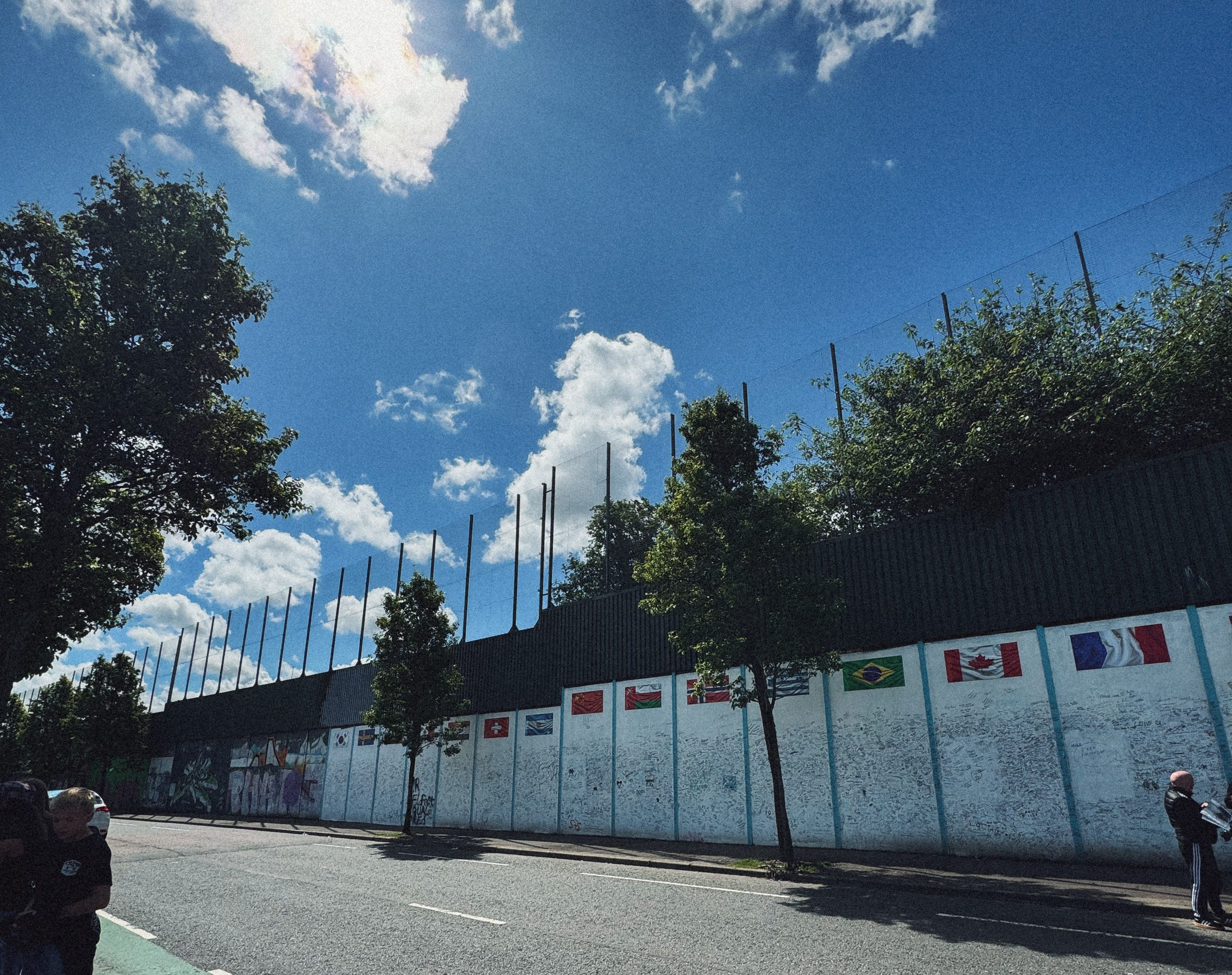
Despite a decades-long ceasefire, the paramilitaries from the Troubles are still active… although the director of this youth center would rather you not call them that: “We need to stop calling them paramilitaries,” he told the BBC last year, although he shared this same sentiment with us. “We are almost dressing them with a respectability of some sort of political agenda. They are purely criminal.” Since the ceasefire, at least 87 children have been shot by these organizations in the area and many more have been beaten, usually as a means of control and discipline of their own.
It is, on the one hand, a unique context of a community grappling with its own story of generational trauma. But I want to be careful not to exoticize it, either. The idea behind our immersion in Northern Ireland was to learn from peacemakers there on the ground, and to bring that wisdom back home, where we have our own stories of sectarianism, violence, and trauma. A youth center here serving a migrant worker community, or some of our neighborhoods most impacted by gun violence, or in the places blighted by opioids and fentanyl… all would have their own flavor of similar dynamics: violence, poverty, oppression, trauma going back generations.
I raise this particular center in Belfast, though, in part because I was just there and because I got to learn about the incredible work they are doing to disrupt those patterns and change the narrative for the neighborhood and its young people. That work is deeply rooted in making sure the kids there know they are loved. As Urie Bronfenbrenner once said, “Every child needs at least one adult who is irrationally crazy about him or her.” The center seeks to be those irrationally crazy adults.
And so, the center does not kick kids out… even when they are especially difficult or problematic… even when most other providers would. Some of the participants are young people who did get kicked out or turned away from other places, but this center doesn’t give up on them. It believes that all behavior is communication. So it seeks to identify and address what need is being communicated rather than to punish and exclude based on behavior.
The director–Stephen–notices when a young person misses youth club. He follows up with them to see what’s going on and works to get them coming back. He doesn’t let them fall through the cracks. Now, this part will feel shocking to us here in the American police state, but the police there actually call the center when rioting breaks out along the interface, and workers from the center hit the streets to extricate their kids and deescalate the situation. It turns out, sometimes love looks like a firm threat to call your mother and tell her just what you’re up to.
There’s a sense that if you get up to no good out there in the city, Stephen and others at the center will chase you down and find you. That you can’t disappear into the sort of life that may feel inevitable to a kid in these circumstances… because there is a group of people who cares enough about you to find you, every time.
There’s a sense that, when you join this center, nothing can separate you from its love…
And maybe this is how you really preach Romans 8. Not by anything I might say up here, but by showing that kind of divinely unseverable love.
But I suppose I’ll say a few more things while I’m up here, anyway… starting with the idea that this passage from today, as with the entire letter of Romans, has some pretty strong theological assertions. In the middle, sandwiched between some of Christianity’s greatest hits of “all things work together for good ” and “nothing in all Creation can separate us from the love of God in Christ Jesus,” there is language about being foreknown and predestined, and predestined and called, and called and justified, and justified and glorified. Those are certainly some loaded terms, with plenty of debate about just what their precise meaning is. Words with lots more words to be said about them. As Presbyterians, maybe we especially start to sweat at the mention of “predestination” in there. How ever are we going to explain this complicated doctrine that so often gets reduced in the public consciousness to something that sounds, quite frankly, capricious and cruel?
But then Paul poses his own question along similar lines: “What, then, are we to say about these things?” What are we left to say in light of what we believe? This then launches a series of still more rhetorical questions, ending in his stunning conclusion: “For I am convinced that neither death, nor life, nor angels, nor rulers, nor things present, nor things to come, nor powers, nor height, nor depth, nor anything else in all creation will be able to separate us from the love of God in Christ Jesus our Lord.”
So what is it that we are to say?
I think it’s that “all of these things”–our doctrines, our belief systems, our theology–ought to ultimately point to God’s boundless love. That if they don’t, perhaps we’ve missed the point.
Maybe it’s even that you don’t necessarily have to say anything at all. Just point towards love.
Robert Jewett writes in his commentary on Romans, “Paul’s aim here is not to establish an abstract doctrine of predestination . . . , or to invite ‘reflection on the classic problems of determinism and free will,’ but to reassure the vulnerable, harried believers in Rome that their lives and work have significance in the grand plan of God for the restoration of the creation. . .” (529).
It’s about vulnerable, harried people understanding that they and their lives matter to God–the God who is for them and who loves them.
Which is something this youth center I’ve been talking about strives to impart to the young people it serves. You matter to us at the center, which is just a reflection of the ultimate truth that you matter to God.
So often this verse there at the end–”nothing can separate us from the love of God”–is received as a sort of personal comfort, affirming our own ever-connectedness to God’s loving nature. And it truly has been exactly this for me on many occasions, as I hope it has been and will continue to be for you, too… But in thinking about the alienated community of Jesus followers in the heart of the Roman empire to whom Paul writes here, and thinking about communities of alienated folks in our own realities, I’m reflecting on this passage as also an invitation.
That is to say, if nothing can separate any one of us from God’s love, then this passage is also asking us to see others as wholly loved by God, too. Maybe it’s a call, especially, to expand the reach of our own love in kind, to reach those whom the world would have us sever off and discard… A call to live into the divine model of relentless, inseparable love in ways beyond ourselves.
You know, another interesting thing about this center is that it’s run through a church, but it’s not especially “religious” in its programming. Stephen explained that the kids aren’t going to hear you if you try talking to them about God explicitly. That comes from him really knowing these kids, where they’re at, and how to reach them. And so the guiding philosophy for their work, as people of deep conviction and faith, is a quote often attributed to St. Francis:
“Preach the Gospel at all times, and, if necessary, use words.”
This means that much of what they do is the practice of wordless preaching. And somehow in it, I think the Gospel gets heard, loud and clear.
Now, when it comes to words, though, Romans happens to be the wordiest of Paul’s letters, as it is, in fact, the longest. Yet, here in this final section of the eighth chapter, there’s recognition of the places words can’t reach. There is this relatable question Paul poses of, “what then are we to say about these things?” But, moreover, the opening verses of today’s selection talk about the Spirit interceding for us “with groanings too deep for words.” The verses preceding today’s passage give us the context for such groanings: Paul is writing about the suffering of a people caught between the world as it is and the world as it might be… the world being birthed. In the suffering of that in-between reality, words sometimes do not suffice. We are left speechless.
It’s a sort of speechlessness we surely know. I felt it hearing about the reality of lives–especially children’s lives–along a dividing wall an ocean away; in fact, a colleague of mine there described feeling the sensation of horror almost grabbing hold of their throat during the more detailed descriptions of the violence enacted on children in that community… a truly embodied experience of speech being suddenly arrested.
I’ve known this sort of speechlessness, too, in the wake of far too many school shootings here in this country… in the stories of immigrants and refugees, of what they flee from and what they face once here… in the dire climate prognosis for our planet… with every death warrant signed, particularly as this state seeks to execute two men on one day this coming Tuesday. There’s no way to make sense of any of it, and so what are we to say?
In light of what we believe, and, now, in light of what we experience as the realities of this world, what then are we to say?
Paul affirms that in such times, we very well may not know what to say… But the remarkable thing is, neither does the Spirit. In their book Romans, Disarmed, Sylvia Keesmaat and Brian Walsh write of this verse, “You see, the Holy Spirit cannot take our inarticulate prayers and translate them into words for God, because the Holy Spirit is just as much at a loss for words as we are.” (375) God understands, whether we find words or not. The Spirit joins us in that truly wordless place. And maybe we can rest assured knowing the Spirit’s intercession here is not equipping us to systematically explain away the question of theodicy–why suffering happens–but rather is about her presence with us.
The authors go on to write, “we may have nothing to say, but that doesn’t mean we have nothing to do.” (377) The Spirit intercedes for us, and she invites us into her work–work that points, always, to God’s love.
Which is what I found so inspiring about this center in Belfast and why I wanted to share a little bit about it here. It tells of the Spirit’s intercessions in the places of suffering, trauma, violence, poverty, where words cannot suffice. It tells how those intercessions take shape in the people who answer the call to work alongside her in those places and how, in answering that call, they show God’s love to those who so often hear a different, loveless story from the affliction, distress, persecution, famine, nakedness, perils, and swords of this world…
It is a center full of people who have come to trust in their own faith lives that nothing can separate them from the love of God… who then turn and show that truth to others who don’t yet know that same conviction, who don’t fully grasp their own belovedness.
But they start to.
And it happens so often through the wordless preaching of the Gospel in the places and circumstances that leave us speechless.
Romans 8: 26-39 (NRSVUE)
Likewise the Spirit helps us in our weakness, for we do not know how to pray as we ought, but that very Spirit intercedes with groanings too deep for words. And God, who searches hearts, knows what is the mind of the Spirit, because the Spirit intercedes for the saints according to the will of God.
We know that all things work together for good for those who love God, who are called according to his purpose.
For those whom he foreknew he also predestined to be conformed to the image of his Son, in order that he might be the firstborn within a large family. And those whom he predestined he also called, and those whom he called he also justified, and those whom he justified he also glorified.
What then are we to say about these things? If God is for us, who is against us? He who did not withhold his own Son but gave him up for all of us, how will he not with him also give us everything else? Who will bring any charge against God’s elect? It is God who justifies. Who is to condemn? It is Christ who died, or rather, who was raised, who is also at the right hand of God, who also intercedes for us.
Who will separate us from the love of Christ? Will affliction or distress or persecution or famine or nakedness or peril or sword? As it is written, “For your sake we are being killed all day long; we are accounted as sheep to be slaughtered.” No, in all these things we are more than victorious through him who loved us.
For I am convinced that neither death, nor life, nor angels, nor rulers, nor things present, nor things to come, nor powers, nor height, nor depth, nor anything else in all creation will be able to separate us from the love of God in Christ Jesus our Lord.
I’m grateful for your words, Emily.
Very good & practical