Meet Your Heroes
Some initial reflections after my time in Northern Ireland

They say never meet your heroes. Having been disappointed by people I’d looked up to myself, I suppose I understand why the proverbial “they” says such a thing. The romanticization that often accompanies the construction of a “hero” narrative tends to bury a person’s humanity under its weight. That is, we forget that a hero is a person with flaws, some of which can be rather drastically exacerbated by the lionization into hero status.
Over the last two weeks, though, I met a lot of folks you might just call heroes during an immersive peacemaking program in Northern Ireland. Perhaps it’s a question of whom we call heroes and why (which would be a reflection for another day), but I find getting to know them in the fullness of their humanity inspires rather than disappoints.
Let me tell you about just a couple of them…
At one point last week, our group sat in rapt attention over a lunch session with Rev. Harold Good. He, along with Father Alec Reid, oversaw the decommissioning of arms by the IRA in 2005. It is a holy thing to lay down our weapons, so it is especially moving that they selected clergy rather than secular authorities to fulfill this sacred role. That choice signals it as something more than compliance with terms of an agreement. It is an act of faith–a belief that another way is possible.
And a few days ago, I got to share space, a meal, and conversation with one of the ministers who, in fact, made it possible. I got to shake his hand and tell him briefly about my work in Florida politics as he signed a book for me. We connected in a shared desire to see American politics transform. It is an incredible thing, really, to be in the presence of a peacemaking giant.
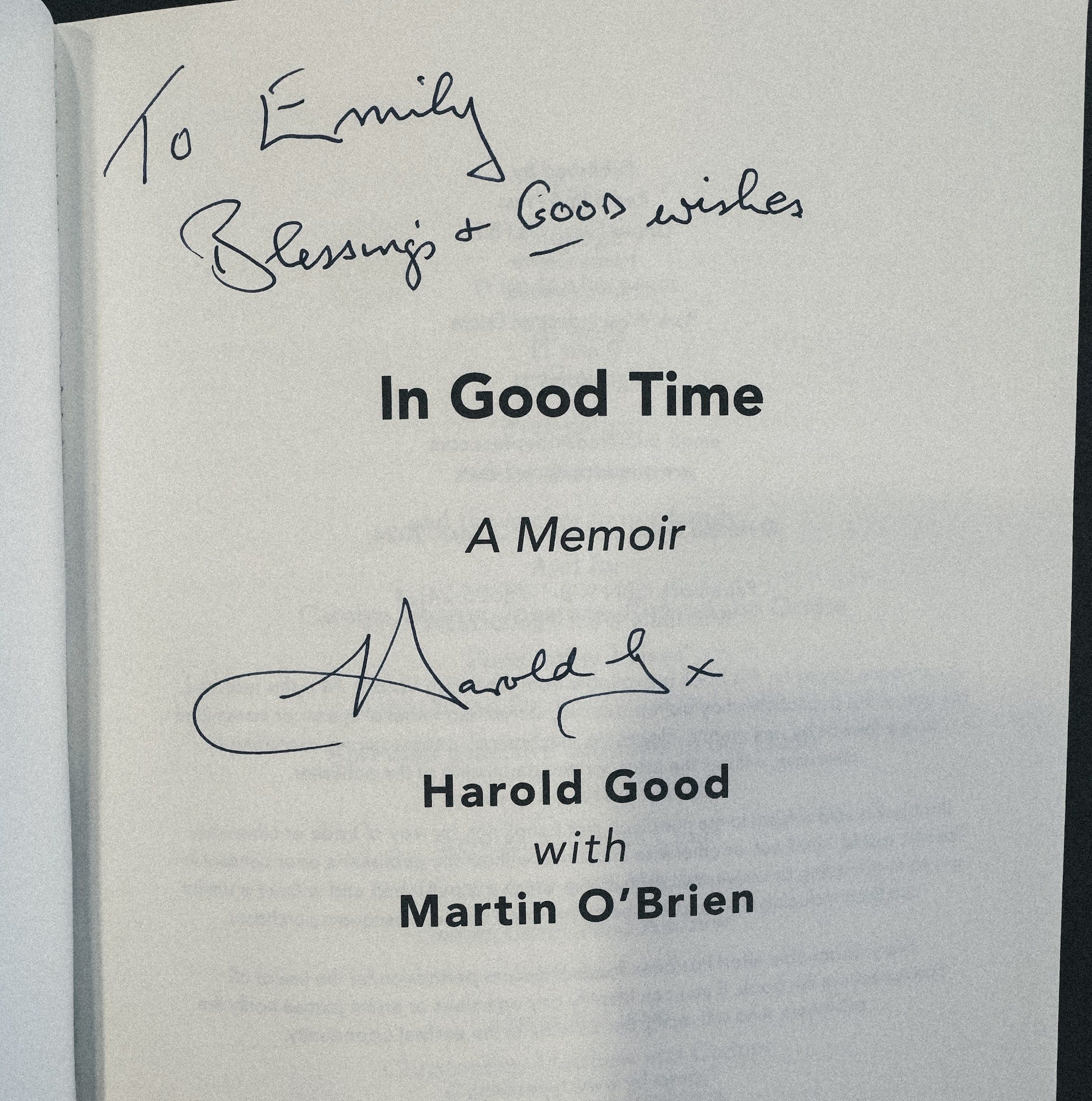
This disarmament of the IRA, which precipitated that of the loyalist paramilitaries, is of course a compelling story… But there are so many stories that precede such a momentous occasion. In his gentle, soft-spokenness, Rev. Good told us of going from the Protestant Shankill neighborhood where he served as a Methodist minister over to the Catholic Falls Road to share in the grief of violence with the people impacted by it there, ask what support they needed, and later deliver a car filled with baby items to meet their needs. He did all this in the name of his Protestant congregation, which in many ways could be taken as being in the name of the “enemy.” Yet his parishioners gathered the items for him to take, and the “other side” graciously received them. He told stories of individual conversations over his wife’s scones that slowly allowed for change in the larger conversation around the Troubles, and of formative experiences in the Jim Crow South before beginning ministry back home in Northern Ireland.
For him, the work happens around the “3 T’s”: talk, truth and trust. Well, maybe 4, he added: Tetley’s (tea).
I met another hero, who was actually in the cohort with me. Mike founded RAWtools, which, among other things, turns unwanted guns into garden tools. I was initially drawn many years ago to the powerful application of “swords to plowshares” to our contemporary context of gun violence, but, as I got increasingly involved, I soon found its transformative effect was far richer than just reshaping metal. It changed me and the trajectory of my life, contributing significantly to my discernment of a call to ministry and reorienting this former prosecutor towards restorative and transformative justice practices and an abolitionist worldview.
One guy’s decision to take up blacksmithing and launch this faithful response to our unbearably pervasive gun violence has profoundly impacted so many, myself included.
And that very guy was in the cohort of growing peacemakers with me, co-learning over the past several months and travelling to Northern Ireland together for this immersive experience. While we’d had many Zoom meetings and grown to be friends in the digital landscape over the years, I got to meet him in person for the first time, in Belfast of all places. I think I played it cool, but this was a really big deal for me (which, in his humble Mennonite way, he played off by reminding me I am technically his boss as a member of the RAWtools board).
It is a gift to transform distanced admiration into collaboration and genuine, IRL friendship. I am so grateful.
As we moved through the city, we kept finding serendipitous connections to RAWtools: people in Belfast for a variety of reasons who knew about the work of Guns to Gardens or knew people doing it. A liturgist at the annual service of lament around the violence in Northern Ireland struck up a conversation with me at the fellowship time following the service, and it turned out she had lived in the States and was the pastor to one of our other board members during that time. The church we worshipped at on our Sunday there has close ties to the RAWtools South affiliate in Asheville. A musician who had accompanied Mike on his book tour for Beating Guns years ago happened to be playing in Belfast while we were there and told the whole audience about RAWtools’ work during the show.
The power of this ministry has spread, truly, around the world.
And the thing is, Mike is just a guy.
Harold Good is just a guy.
The two men we met who work together to bring walls down between their respective Protestant and Catholic neighborhoods… just guys.
The youth workers attending to generational trauma stemming from decades of violent conflict and fiercely loving the kids through the tough challenges that work presents… just a guy and a gal.
They are “just people”… People who have done remarkable things, to be sure, but, more often than not, those remarkable things were made possible through rather small but brave steps made in faith: the belief in something so many others cannot begin to imagine.
Illustrating that point, Harold Good described getting through to a particularly difficult party to the peace negotiations by calling upon Jesus’s words to Thomas: “Have you believed because you have seen me? Blessed are those who have not seen and yet have come to believe.” (John 20:29) He was, in that moment, “just a guy,” acting in faith, pointing to the kin-dom of God, and inviting another to join him in realizing it.
And, well heck, maybe even you or I could do something like that. It may not be on such a grand stage, but we can do similarly in our own communities. Through talk, truth, and trust… and maybe over tea.
So I guess we can choose to be scared of our heroes’ humanity… It’s interesting to me that we have a tendency to dehumanize not only those we look down upon but those we look up to as well. Our humanity is messy and beautiful; we ignore it for the messiness in our heroes and for the beauty in the “other.”
The implication of both can be “scary” in a sense: they are all people, just like us. Better yet, beloved children of God, just like us. That can feel “scary” because it is a great equalizer that asks things of us. It asks us to treat the other with the dignity they are due, for one. But when it comes to our heroes, it refuses to excuse extraordinary work as the prerogative of extraordinary people only. Perhaps it’s that it makes us rethink whether the small but brave acts that create the conditions for peace are really so “extraordinary” at all. It puts such work within our own reach, as fellow “just people.”
I am choosing instead to embrace the humanity of my heroes and draw closer into relationship with them when I can. It’s what Jesus would have us do, I think.
To never meet them is to never know what’s possible.
And another way is possible. May we help each other see it. May we help each other live it.
Good for you for going on that trip! And you make such an interesting point that "we have a tendency to dehumanize not only those we look down upon but those we look up to as well." I had never thought that hero worship and demonizing others had anything in common inside our brains.